
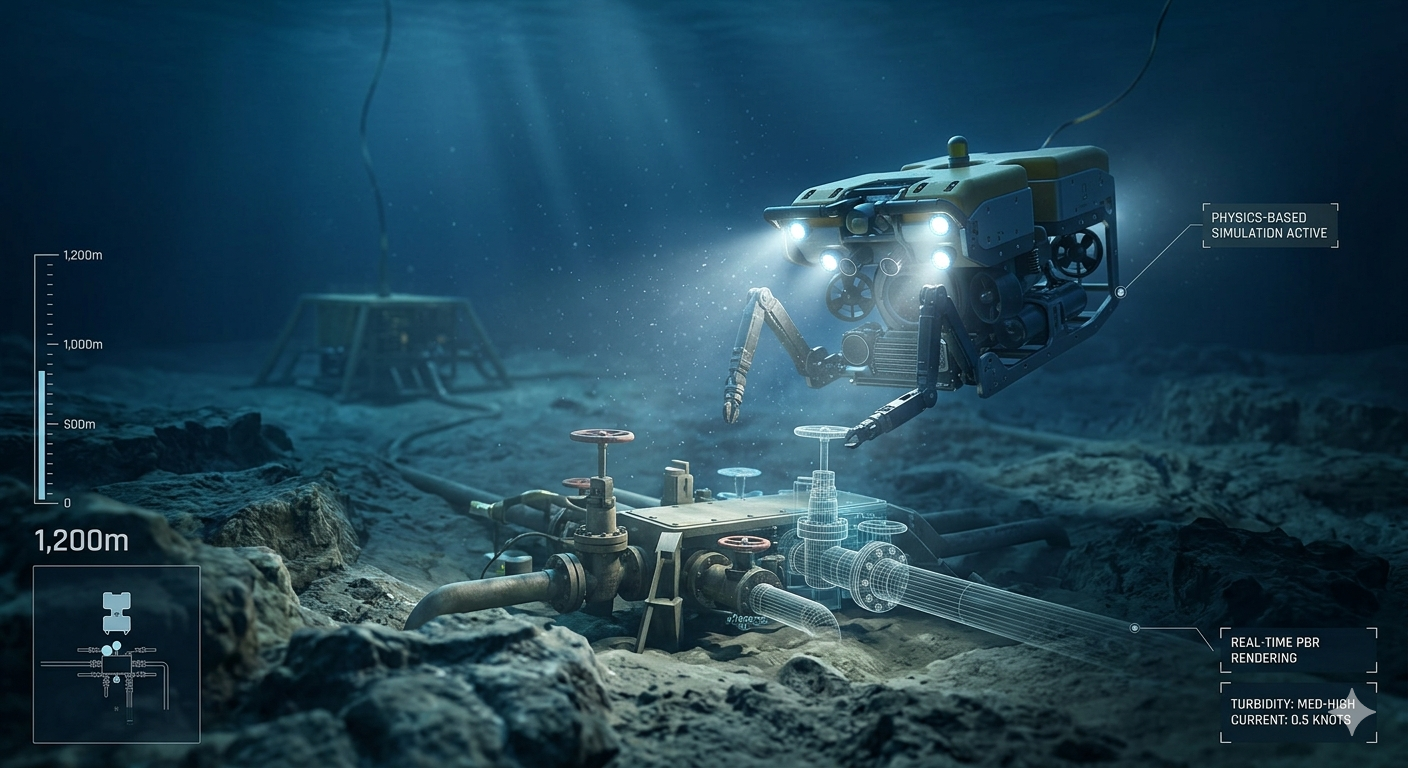
Marine 3D animation is the process of creating three-dimensional digital models and movements of maritime assets (ships, subsea structures, ROVs) within a simulated aquatic environment.
- Core Technologies: It utilizes physics-based rendering (PBR), real-time engines like Unreal Engine 5, and CAD-to-CGI workflows.
- Primary Use: Engineering validation, stakeholder pitching, and operational risk reduction.
- 2026 Trend: Shift toward AI-assisted fluid dynamics and real-time ray-traced underwater lighting.
How does Marine 3D Animation work in an engineering context?
Unlike entertainment-grade CGI, marine 3D animation at Aqua-Viz begins with raw engineering data. We ingest CAD (Computer-Aided Design) files and bathymetric data to ensure that every bolt on an ROV or every contour of the seabed is mathematically accurate. This “Engineering-First” approach allows companies to verify spatial relationships and operational procedures before a single asset is deployed.
Why is real-time rendering the new standard?
In 2026, the industry has moved away from traditional “offline” rendering. By using real-time engines, we can simulate complex maritime environments—complete with variable current speeds, turbidity, and light refraction—instantly. This allows for rapid iteration during the design phase, saving months of lead time.
Lead Artist’s Note: “The biggest challenge in marine animation isn’t the ship; it’s the water. In 2026, we focus on ‘Subsurface Scattering’ to mimic how light actually behaves 500 meters below the surface. This level of realism isn’t just for show—it’s what makes the simulation feel ‘true’ to an engineer’s eye.”