
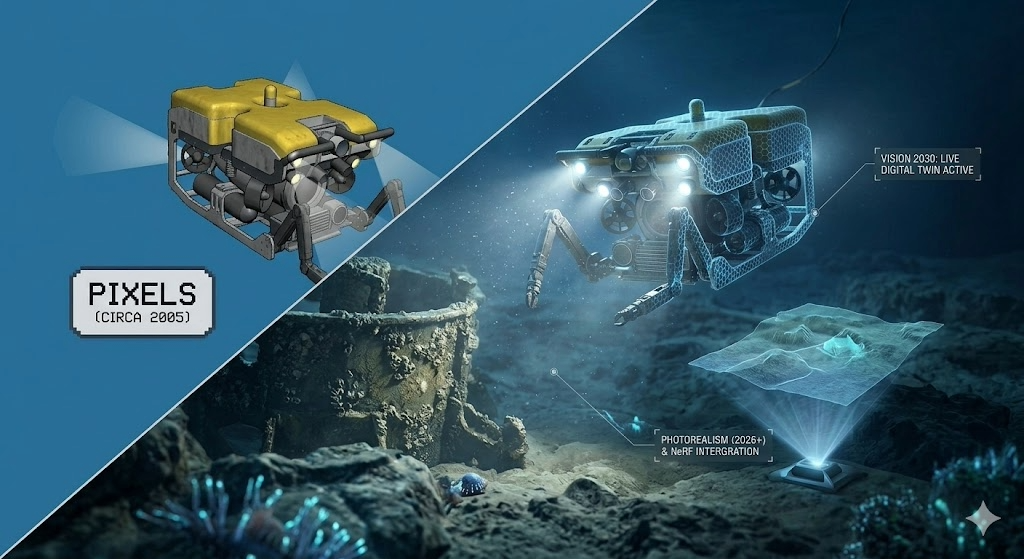
Early marine CGI struggled with “flat” water and unrealistic lighting.
- The Breakthrough: The introduction of Volumetric Lighting and Caustics (light patterns) has bridged the gap to photorealism.
- Future Tech: AI-driven texturing and “Neural Radiance Fields” (NeRFs) are allowing us to turn 2D sonar data into immersive 3D environments.
- Vision 2030: The move toward fully interactive, “playable” maritime simulations for remote operations.
What was the “Uncanny Valley” of marine animation?
For years, underwater CGI felt “fake” because of the way light was handled. Water is a dense medium that absorbs colors differently at various depths (losing reds first). In the past, animations simply looked “blue.” Today, we use spectral rendering to calculate the exact wavelength of light as it travels through particulate matter (marine snow).
How is AI changing the future of underwater visuals?
We are currently entering an era where AI can predict how a ship’s hull will interact with specific wave patterns without needing a full CFD (Computational Fluid Dynamics) run. This means we can produce high-fidelity, scientifically accurate marketing content at a fraction of the previous cost and time.
Where will marine visualization be in five years?
We anticipate a shift from “watching” to “experiencing.” The future lies in “Live Digital Twins”—animations that are connected to real-time sensors on the ship, allowing shore-based teams to see a photorealistic representation of their assets in real-time, regardless of weather or visibility.
Lead Artist’s Note: “We aren’t just making pretty pictures anymore. We are building digital windows into the deep. The jump from 2020 to 2026 in rendering quality is larger than the entire previous decade combined.”