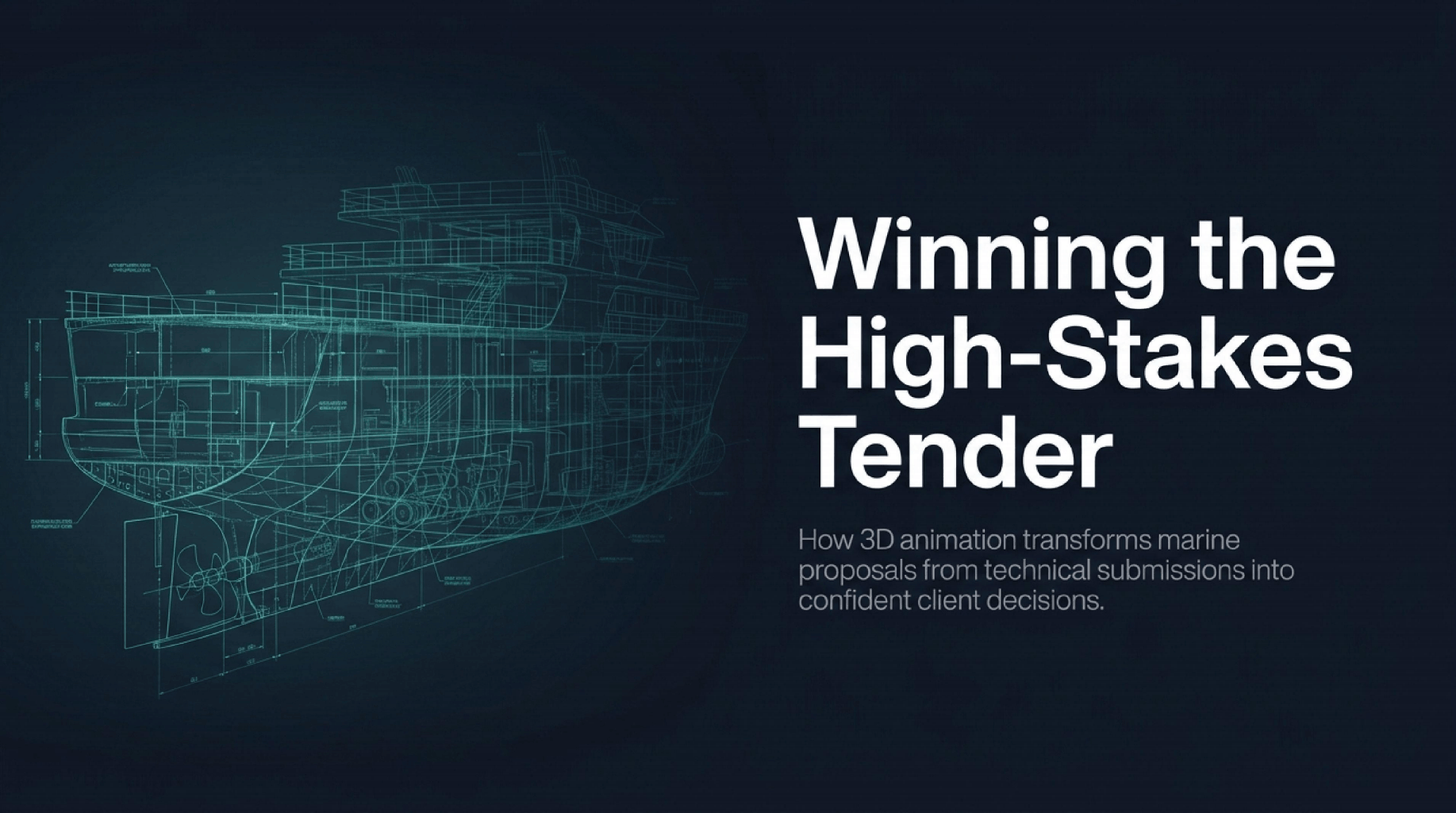
3D animation improves marine proposal success rates by turning complex engineering designs into clear, photorealistic visuals that any stakeholder can understand at a glance. When a client can see exactly what a vessel or offshore structure will look like, how it functions, and how it fits within its environment, they make faster, more confident decisions. For marine and offshore companies competing in high-stakes tenders, that clarity can be the difference between winning and losing a contract.
Key Takeaways
- Photorealistic 3D visuals help non-technical decision-makers understand complex marine designs quickly.
- Animated walkthroughs and fly-through videos communicate scale, layout, and design intent far better than static drawings.
- Visualization works across yacht new builds, commercial vessel conversions, and offshore FEED proposals.
- Bringing 3D visuals into the proposal process early reduces revision cycles and speeds up approvals.
- Naval architect involvement ensures every visual is technically accurate, not just visually impressive.
Why Visual Communication Matters in Marine Proposals
In the marine and offshore sectors, design proposals often involve engineering concepts that are genuinely difficult to explain through technical drawings alone. A set of 2D schematics may be perfectly readable to a naval architect, but to an investor, a shipowner, or a project sponsor sitting across the table, those same drawings can look abstract and hard to interpret. That gap in understanding creates delays, invites unnecessary questions, and slows down the approval process.
Decision-makers at the executive level are not always engineers. They are evaluating risk, investment potential, and design intent. When a proposal relies entirely on CAD outputs and technical blueprints, it puts the burden of interpretation on people who are already under time pressure. Photorealistic 3D visualization removes that burden by showing exactly what the finished project will look like, before a single piece of steel is cut.
Research in engineering and construction consistently supports this. According to the Construction Industry Institute, projects that use visual communication tools during the proposal and design phase experience up to 30% faster stakeholder alignment compared to those that rely solely on technical documentation. In a competitive tender environment, that speed matters enormously. The team that presents a clear, visually compelling proposal is far more likely to move to the next stage of evaluation.
For marine and offshore professionals, this means that 3D animation for marine proposals is no longer a nice addition to a pitch deck. It has become a core communication tool. Clients have come to expect it, and those who do not provide it are starting to fall behind.
What Makes a Proposal Visually Compelling?
A visually compelling marine proposal is one that communicates the design story clearly, builds confidence in the team behind it, and gives the client something they can actually picture. It goes beyond showing what something looks like. It shows how it works, where it sits, how people move through it, and why the design decisions were made. The difference between a good proposal and a great one often comes down to how well it tells that story visually.
Photorealistic Renders vs. Technical Drawings
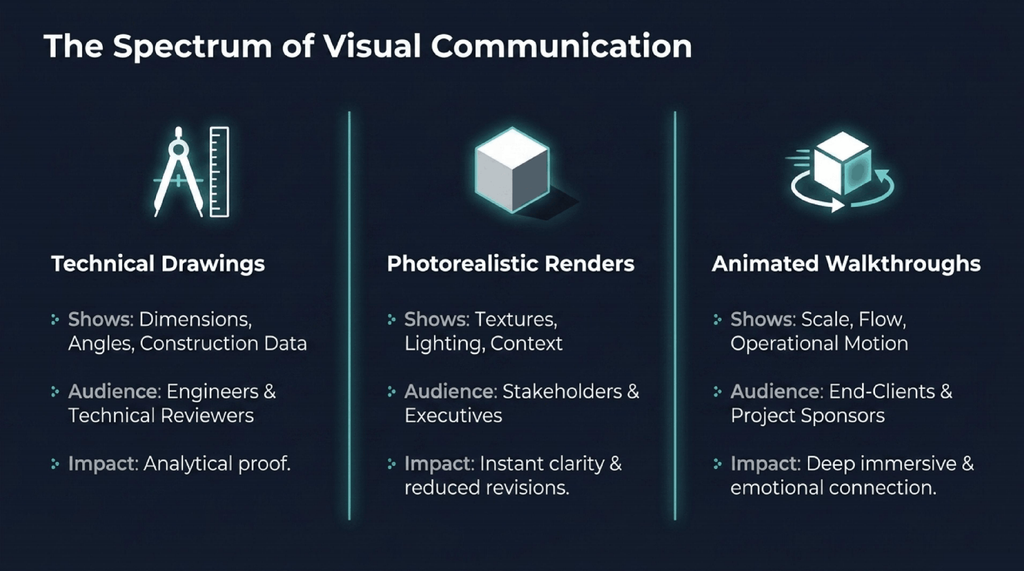
Photorealistic 3D renders show a vessel or offshore structure as it will realistically appear in the real world, with accurate lighting, material textures, water reflections, and surrounding environment. A technical drawing shows dimensions, angles, and construction data. Both are necessary, but they serve entirely different audiences and purposes in a client proposal.
When a client reviews a photorealistic marine render, they immediately understand the scale of the structure, the quality of the finish, and the design intent behind every surface. This builds confidence. It tells them that the team has thought through the details and can deliver a finished product that looks as good as it functions. Technical drawings, by contrast, often raise more questions than they answer for non-technical stakeholders, because the information is presented in a language they were not trained to read.
The practical impact of using photorealistic renders in proposals is that it reduces back-and-forth revisions. When clients can see the design clearly, they give clearer feedback. They know what they like, what they want to change, and what they want to keep. This shortens the revision cycle and moves the project forward faster, which saves time and cost for everyone involved.
Animated Walkthroughs and Fly-Through Videos
Animated walkthroughs and fly-through videos take photorealistic visualization one step further by putting the design in motion. Rather than viewing a single still image, the client is guided through the vessel or offshore structure in a continuous, immersive sequence. They can experience the scale of a main deck, the flow of an interior layout, or the complexity of a topside installation, all before construction begins.
This motion element carries real emotional weight. When a high-end yacht client watches a fly-through of their proposed new build, they are not just reviewing a design. They are experiencing the lifestyle that comes with it. For offshore structure stakeholders, seeing an animated installation sequence helps them understand operational logic and risk configurations in a way that no diagram can replicate. The combination of emotional connection and practical clarity makes animated sequences one of the most powerful tools in any marine client proposal.
How 3D Visualization Supports Different Marine Proposal Types
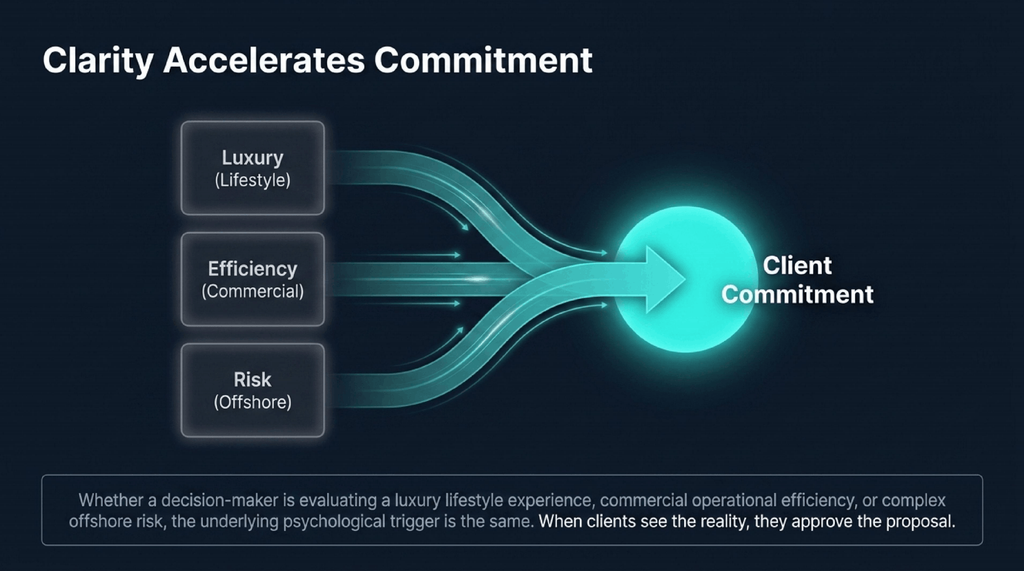
Photorealistic 3D visualization, which is the process of generating highly realistic digital images or animations from 3D models, adapts naturally to the wide range of project types within the marine and offshore world. Whether the proposal is for a luxury yacht new build, a commercial vessel conversion, or a complex offshore platform, the core value is the same: turning technical intent into something a client can see and understand clearly.
Yacht and Luxury Vessel Proposals
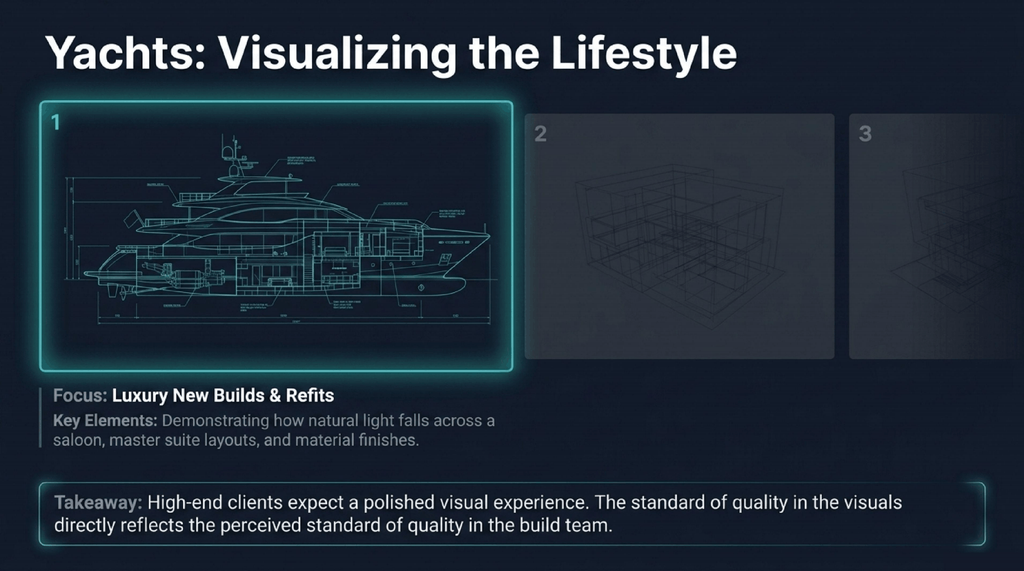
In the yacht and luxury vessel market, high-end clients expect a polished, detailed visual experience as a standard part of any new build or refit proposal. These clients are investing significant sums, and they want to see exactly what they are getting. A rough CAD export or a low-resolution sketch simply does not meet that expectation.
Interior visualization is particularly important in yacht proposals. Clients want to see how natural light falls across a saloon, how the master suite is laid out, what materials and finishes have been chosen, and how the overall aesthetic holds together. Exterior renders showing the vessel on open water, with accurate hull lines, deck detailing, and environmental context, help the client feel confident that the design is both beautiful and seaworthy. For yacht proposal 3D visualization, the standard of quality in the visuals directly reflects the perceived standard of quality in the build team.
Ship and Commercial Vessel Proposals
Commercial shipping clients operate in a world driven by efficiency, safety, and regulatory compliance. When a shipowner or fleet operator is evaluating a conversion proposal, a structural modification, or a new build design, they need to understand how the changes will affect operational performance and layout logic. 3D visualization for ship proposals gives them that understanding in a format that is far faster to process than written specifications or engineering drawings.
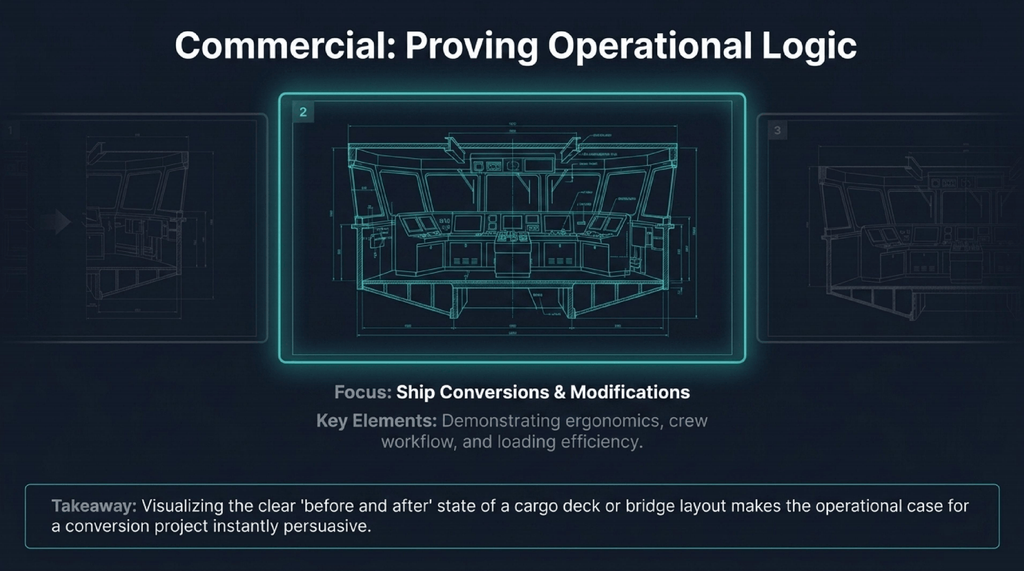
An animated walkthrough of a cargo deck modification shows exactly how loading efficiency will improve. A 3D render of a revised bridge layout communicates ergonomics and crew workflow in a way that a floor plan simply cannot. For ship conversion proposals in particular, visualization helps stakeholders compare the before and after state of the vessel clearly, which makes the case for the project far more persuasive.
Offshore Structure and Platform Proposals
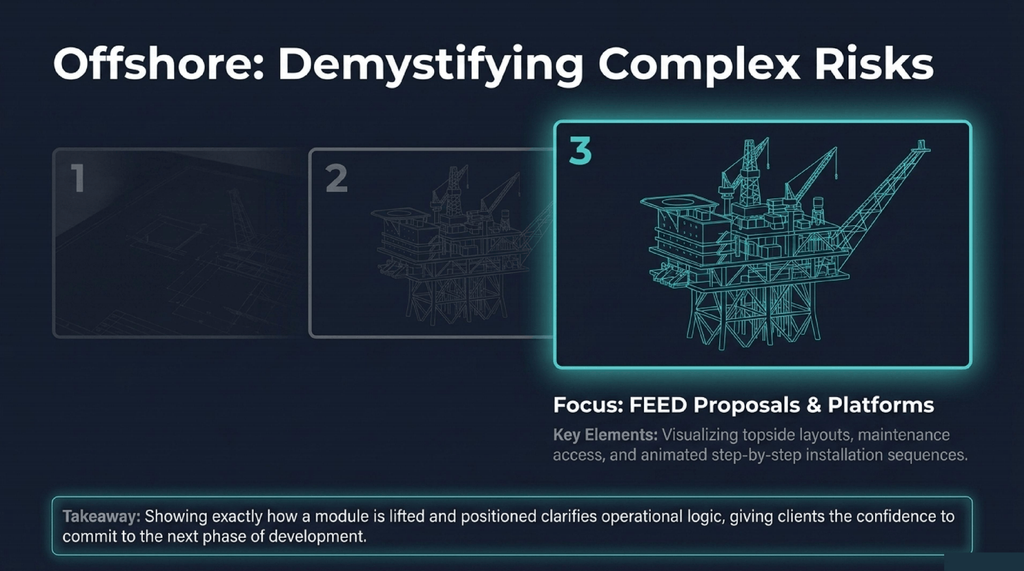
Offshore structure and platform proposals are among the most technically complex documents in any industry. They involve installation sequences, topside equipment layouts, safety configurations, mooring systems, and structural load considerations, all of which need to be communicated to a diverse group of stakeholders that includes engineers, operations teams, investors, and regulators.
Offshore structure animation brings all of that complexity into focus. An animated installation sequence can show exactly how a module is lifted and positioned on a platform, step by step. A 3D topside layout render can show where equipment sits, how maintenance access is managed, and how emergency egress routes are configured. For offshore FEED proposals and early-stage project visualizations, this level of clarity gives clients the confidence to move forward and commit to the next phase of development.
The Role of Naval Architects in Proposal Visualization
One of the most important factors that separates strong marine proposal visuals from generic 3D renders is technical accuracy. A visually stunning image that shows a hull with the wrong proportions, incorrect freeboard, or an implausible structural arrangement will undermine trust rather than build it. Experienced marine clients and engineers will notice these errors immediately, and they will question the credibility of the entire proposal.
This is why having naval architects directly involved in the visualization process matters so much. Naval architects bring the engineering knowledge needed to ensure that every visual reflects real-world design logic. They understand stability principles, structural behavior, regulatory requirements, and operational constraints. When that expertise is combined with the skills of creative visual artists, the result is imagery that is both photorealistic and structurally credible.
At AquaViz, this combination is central to how every project is approached. The team includes naval architects and visual artists working alongside each other from the earliest stages of a project. This means that a photorealistic exterior render of an offshore platform is not just a beautiful image. It is an accurate representation of a design that has been reviewed with engineering intent in mind. For clients presenting proposals to technically sophisticated audiences, that credibility is a genuine competitive advantage.
What to Include in a 3D-Powered Marine Proposal
A strong 3D-powered marine proposal includes a range of visual assets that work together to tell the full design story. No single image or animation covers everything a client needs to understand, so a well-structured proposal uses different visual formats to address different aspects of the project.
Photorealistic exterior renders are the foundation. They show the vessel or structure as it will appear in its final form, set within a realistic environment. These images create the first impression and set the visual standard for the entire proposal. Interior walkthroughs follow, giving the client a detailed look at how spaces are arranged, how they feel at human scale, and how design choices translate into the finished environment.
Exploded component views are particularly useful in technical marine proposals. They show how individual parts of a vessel or structure fit together, which helps clients and engineering teams understand assembly logic and system integration. Animated assembly sequences take this a step further by showing the construction or installation process in motion, step by step. Environmental context shots, which place the design within realistic sea, port, or offshore conditions, complete the package by showing how the project will look and function in its actual operating environment.
How Early Should Visualization Enter the Proposal Process?
Visualization should enter the marine proposal process as early as possible, ideally at the concept design stage. This is a question many marine and offshore teams get wrong. They treat 3D visuals as a finishing touch, something to add once the design is nearly complete. In practice, early visualization creates far more value.
When photorealistic visuals are produced at the concept stage, they give the entire project team a shared reference point. Stakeholders, clients, and engineering teams are all looking at the same image of what the design could be. This alignment reduces the risk of misunderstanding, catches design conflicts early, and prevents the kind of late-stage revisions that cost both time and money.
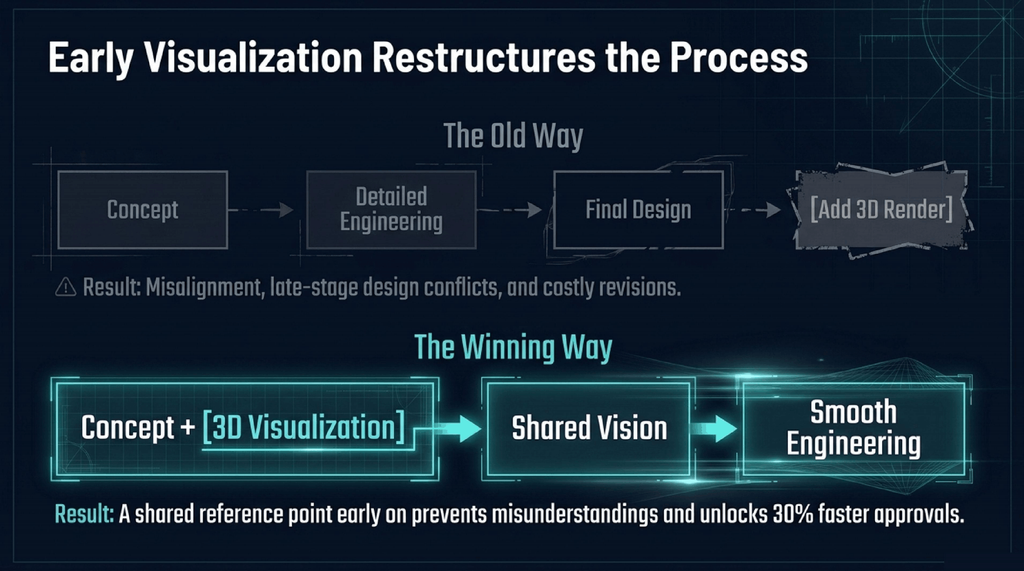
For offshore FEED proposals and yacht new build presentations in particular, early-stage visualization also signals professionalism and commitment to the client. It shows that the team has invested real effort in communicating the vision, not just the technical specification. Clients respond to that. It builds trust, and trust is what wins proposals.
Common Mistakes to Avoid in Marine Proposal Presentations
Even experienced marine and offshore teams make presentation mistakes that weaken otherwise strong proposals. Knowing what to avoid is just as important as knowing what to include.
Relying solely on CAD exports is one of the most common errors. Raw CAD outputs are useful for engineering review but are not client-facing documents. They lack texture, lighting, environmental context, and any sense of visual quality. Presenting them to non-technical stakeholders sends the wrong message about the team’s attention to detail. Low-resolution renders are a related problem. A blurry or pixelated image suggests a rushed or low-investment approach, which is the last impression any proposal team wants to create.
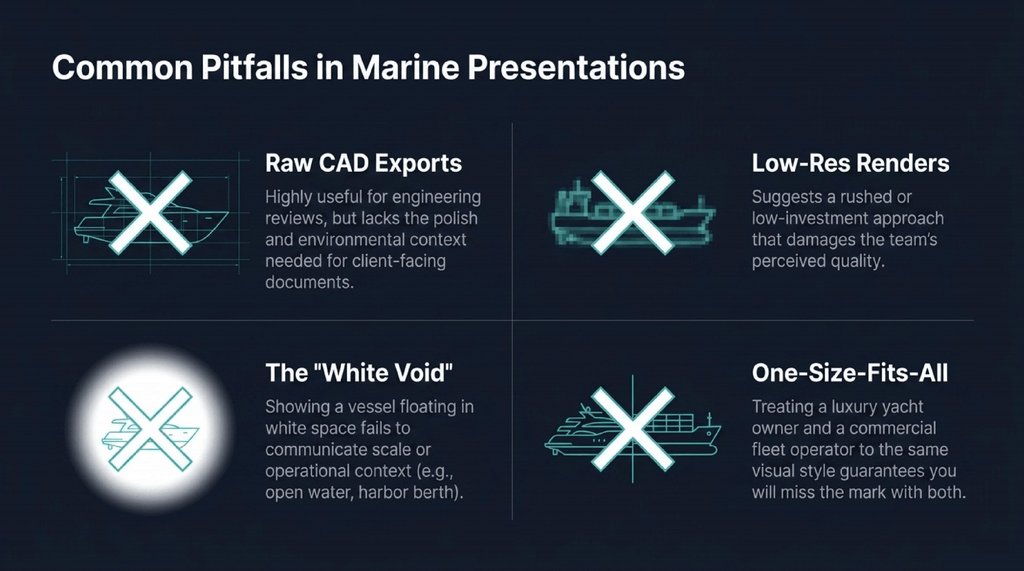
Neglecting environmental context is another frequent oversight. A vessel render that appears to float in a white void tells only part of the design story. Placing the same vessel on open water, at a harbor berth, or alongside an offshore platform immediately communicates scale, operational context, and design purpose. Failing to tailor visuals to the specific client audience is perhaps the most strategic mistake of all. A luxury yacht owner and a commercial fleet operator have entirely different visual expectations and priorities. Proposals that treat all clients the same tend to miss the mark with both.
Frequently Asked Questions
What is the difference between a 3D render and a 3D animation in a marine proposal?
A 3D render is a single still image produced from a 3D model, showing the design from a fixed viewpoint with realistic lighting, materials, and environmental context. A 3D animation is a moving sequence that guides the viewer through or around the design, showing it from multiple angles and perspectives over time. In marine proposals, renders are typically used for exterior and interior presentation images, while animations are used for walkthroughs, fly-throughs, and installation or assembly sequences.
How long does it take to produce 3D visualization assets for a marine client proposal?
The timeline depends on the scope and complexity of the project. A set of photorealistic exterior renders for a yacht proposal can typically be produced within one to two weeks. A full animation package for an offshore structure proposal, including installation sequences and topside walkthroughs, may take four to eight weeks. Starting the visualization process early in the proposal development phase helps ensure that assets are ready when the proposal deadline arrives.
Can 3D animation be used for offshore project proposals at early design stages?
Yes. 3D animation is particularly well suited to early-stage offshore proposals, including FEED proposals, because it communicates design intent without requiring fully detailed engineering drawings. Concept-level 3D models can be used to produce animations that show overall layout, scale, installation logic, and operational context. This helps clients and stakeholders understand the project direction and make informed decisions well before detailed design begins.
How does photorealistic visualization help win competitive marine tenders?
In a competitive tender environment, proposals that include high-quality photorealistic visuals stand out immediately. They demonstrate that the submitting team has invested in clear communication, understands the client’s expectations, and can deliver a finished product that meets a high visual and technical standard. Decision-makers reviewing multiple tender submissions are naturally drawn to proposals that are easy to understand and visually engaging. Photorealistic marine renders provide both of those qualities.
Do I need finalized engineering drawings before commissioning 3D visuals for a proposal?
No. 3D visualization can begin at the concept or preliminary design stage, using early-stage drawings, sketches, or reference models as the starting point. In fact, producing visuals before the design is fully finalized can help identify layout issues and design conflicts early, saving time and cost in the long run. The 3D model can be updated as the engineering design develops, keeping the visuals aligned with the latest version of the project.
What types of marine and offshore projects benefit most from 3D animation in proposals?
Virtually all marine and offshore project types benefit from 3D animation in proposals, but the impact is greatest for projects that involve complex spatial arrangements, large capital investment, or non-technical decision-makers. Yacht new builds and refits, commercial vessel conversions, offshore platform installations, subsea infrastructure projects, and port and terminal designs are among the categories where visualization adds the most value to a client proposal.
How does combining naval architecture expertise with 3D visualization improve proposal credibility?
When naval architects are involved in producing visualization assets, the resulting images and animations reflect genuine engineering intent. Proportions are correct, structural arrangements are logical, and operational configurations are realistic. This level of accuracy is immediately apparent to technically trained reviewers, and it builds confidence in the entire proposal. It signals that the team behind the visuals understands not just how to make something look good, but how to make something that actually works.